
Beyond Automation: The Age of Agentic AI
Agency, autonomy, and the orchestration of intelligent enterprise systems
March 2026
Donna Fluss
Agentic AI has many definitions, as how it is understood and explained varies by audience, application provider (vendor), or user. The market agrees that agentic AI is an AI class with agency that delivers to the market autonomous systems that can act on their own. It also agrees that agentic AI is intended to have self-learning capabilities, although this area still requires more development.
Vendor Perspective
From the vendor perspective, agentic AI is an intelligent development framework that supports the design and deployment of autonomous and context-aware systems that are operationalized through adaptive, AI-enabled enterprise architectures and evolving governance protocols. AI agents are engineered to perceive, identify goals, reason, steer workflows, and act independently across complex technical and multimodal environments. Their agency enables them to autonomously set goals, make decisions, take actions, adapt, and self-improve in real-time. Although they are autonomous by design, they require human oversight and must be guided by ethical guardrails and controls.
Shift from Task-Oriented to Goal-Driven
Agentic AI shifts the service blueprint from passive execution to dynamic orchestration. Agentic AI systems serve as operational partners that can contribute original insights, refine processes, and interact with humans, other systems, or AI agents. This marks a shift in intelligent systems from task-oriented assistance tools to goal-driven AI agents with agency that co-create, understand, navigate nuance and sentiment, and execute in a manner aligned with human intents and enterprise objectives.
Agency is Defining Characteristic
Agency, a core attribute of this class of AI, is a composite capability resulting from multiple interconnected guiding principles working together. As seen in the Agentic AI framework in Figure 1 below, the five stages of agentic AI are:
- Perceive and Understand – Comprehension, Awareness, Memory
- Align and Adapt: Autonomous, Goal Fluidity, Learning
- Cognition and Reason: Proactive, Probabilistic, Decisioning, Explainability
- Relate and Collaborate: Empathy, Role Awareness, Collaboration, Guardrails, Ethics
- Execute: Act Purposefully
Figure 1: Agentic AI Framework
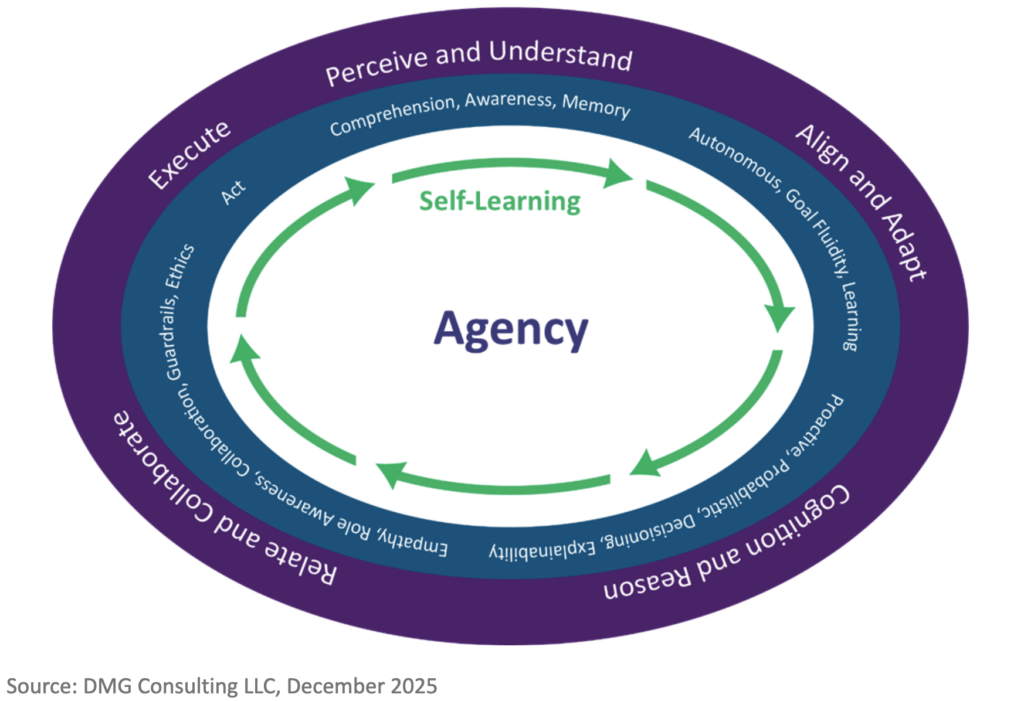
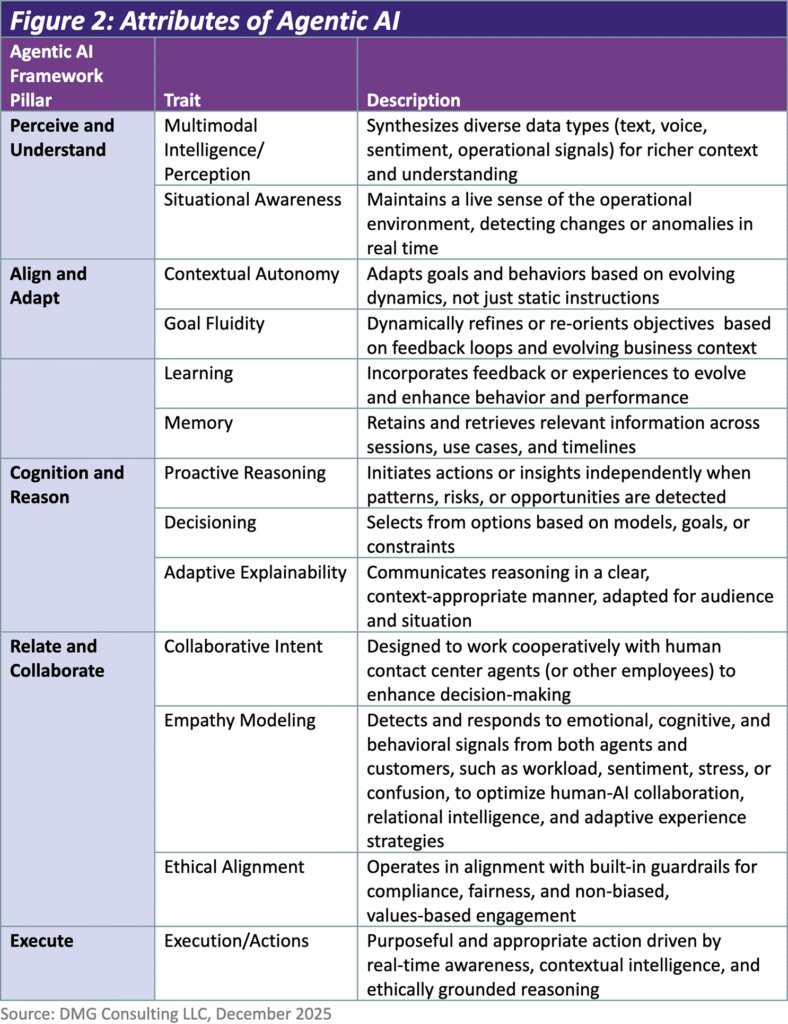
Agentic AI systems represent a new class of autonomous AI agents engineered to collaborate, adapt, and evolve contextually. To operationalize the agentic AI paradigm, it’s essential to understand the foundational traits that distinguish them from traditional AI architectures: multimodal intelligence, ethical reasoning, dynamic orchestration, and interaction models that are human-aware. These traits are the qualities that make agentic AI “agent-like.” Figure 2 details the attributes that enable each of the five foundational areas depicted in Figure 1.
Final Thoughts
Agentic AI technology has the potential to fundamentally reshape the CX software landscape over the next few years, due to its ability to understand context, make autonomous decisions, and adapt in real-time, generally without human intervention. Unlike traditional automation, like workflows or robotic process automation that follow predefined scripts/flows, agentic systems are designed to navigate ambiguity, learn from each interaction, and take appropriate action across increasingly complex human journeys.
However, as the market is in its early stages, expect significant variations in how vendors define and implement agentic AI as they enhance their existing platforms and solutions to bring new capabilities to market. Some will offer increasingly autonomous systems that are capable of multi-step reasoning and decision-making; others will rebrand existing solutions and bots and claim that they have agentic capabilities. CX, IT, and AI leaders must look beyond the marketing claims and evaluate solutions based on concrete criteria that include the following requirements: Can the bot/system handle multi-turn and multi-modal conversations with evolving context? Can the bot learn and improve autonomously? Can the bot take actions across systems without human approval? Enterprises need to approach the adoption and use of agentic AI strategically, rather than opportunistically. This means starting by identifying clear use cases, establishing robust governance frameworks and building the integrations required to access the required data and execute actions.
DMG Consulting is at the forefront of these innovations and in helping companies successfully adopt and implement these new capabilities that will play a highly influential role in the future of CX and the customer journey. Please reach out to Donna Fluss, president of DMG Consulting, for help in selecting, planning, and implementing this new class of systems.